
Incident Command System Overview
Search and Rescue Model
Elizabeth Anderson
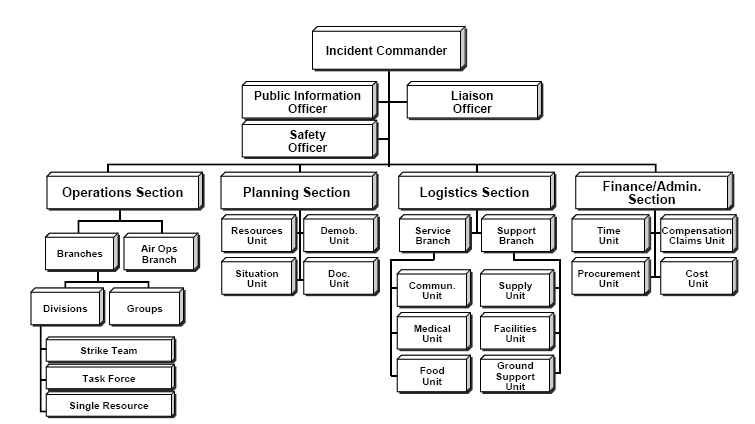
Components of the ICS:
Common Terminology
Modular Organization
Integrated Communications
Unified Command Structure
Consolidated Action Plans
Manageable Span of Control
Predesignated Incident Facilities
Comprehensive Resource Management
Unit Leader
Crew Leader
Common Organizational Titles
Incident Commander (IC)
Deputy
Section Chief
Branch Director
Division Supervisor
Unit Lead
Communications Unit
Group Supervisors
Resource Titles
Single Resource
The smallest unit that can operate independently.
Equipment plus the required individuals to properly use it.
Can be a helicopter, ambulance, search dog and handler etc.
Task Force
Any combination of resources which can be temporarily assembled for a specific mission.
Established to meet a specific tactical need.
Strike Team
A set number of resources of the same kind and type, which have an established minimum number of personnel.
Can be made up of 4X4s, search crews, search dogs and handlers, aid vehicles etc.
Organization Five Functional Components
Command/Management
Operations
Planning
Logistics
Finance
Additional ICS Terms
Command Staff
Consists of the information officer, safety officer, and liaison officer, who reports directly to the incident commander.
Division
That organizational level having responsibility for operations within a defined geographical area or with functional responsibility. The division level is organizationally between the strike team and the branch.
General Staff
A functional division (e.g., air support, search group, rescue group, etc.) Incident action plan the SAR action plan, which is initially prepared when the mission is confirmed, contains general control objectives that reflect overall strategy, and specific plans for the first operational period. When complete, the action plans could have a number of attachments.
Incident Commander (IC)
The individual responsible for the management of the search and rescue operation.
Unit
The individual responsible for the management of the search and rescue operation.
Good management is the key to a successful search and rescue (SAR) mission. It is important that everyone involved in a SAR mission has an understanding of all levels of the organizational structure. “What good does it do to call a person Incident Commander if no one really knows what that means.” The Incident Command System (ICS) is a “standardized, on-scene, all-risk incident management” method and has “basic common elements in organization, terminology, and procedures.”
The use of ICS will ensure that SAR teams will be able to efficiently communicate and work together on SAR missions. The organizational structure can also be adapted to any type of SAR mission, from small scale missing persons to large scale situations involving multiple agencies.
The use of common and standardized terminology will ensure that our platform for volunteers will be understandable across the country. It will also ensure that our categories for creating teams will be accurate. ICS Span of Control guidelines will also ensure that there are limits to how many volunteers a Unit Leader can manage. “Within the ICS, the span of control of any individual with emergency management responsibility should range from three to seven – with five being established as the general optimum (pending certain exceptions).”
By using ICS guidelines, our volunteer platform will be accurate and easy to learn for SAR teams that are not currently implementing ICS.
The University of Montana. (n.d.). Incident command system overview search and rescue model. Retrieved November 16, 2022, from https://winapps.umt.edu/winapps/media2/wilderness/toolboxes/documents/sar/ICS-SAR_overview.pdf